The Hidden Business Behind Every Click and Scroll
The Hidden Business Behind Every Click and Scroll
Data is not just a byproduct of online interaction in the digital age but a currency of the Internet. Every movement we make online, such as clicking, sharing, scrolling, pausing, and more, contributes to the growth of behavioral information that technology companies are turning into business profits. As users, we often communicate with the platform for free, but what many people do not realize is that our interests and actions are important assets that businesses monetize on a large scale.
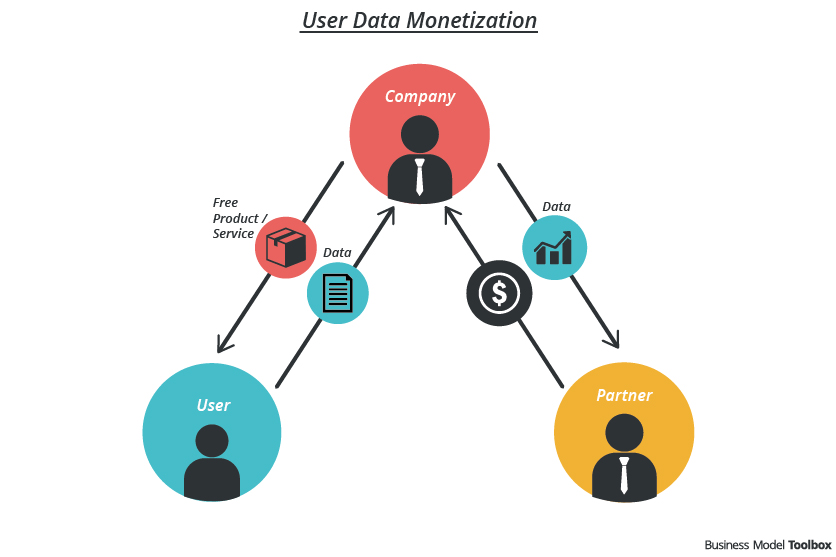
The process of obtaining insights from data and creating economic value based on them is at the heart of data monetization. Most internet-based businesses include collecting data from users, analyzing behavioral patterns, and using these insights for service optimization internally or selling them to advertisers and third-party suppliers externally. The key to this process is to translate into a model that predicts consumer behavior by tracking and aggregating seemingly small behaviors, such as what users search for, who they follow, and how long they stay in posts.
Few companies have implemented this model's system more clearly than Google and Meta (formerly Facebook). These tech giants raise their capital with advertising revenue based on users' data. Google's platforms, including search, YouTube, and Android, collect vast amounts of data about users' interests, locations, browsing history, and more. This information is fed into Google Ads, one of the leading targeting advertising engines. Similarly, Meta collects data from various apps, such as Facebook, Instagram, and WhatsApp, building detailed behavioral profiles that advertisers can use to accurately target the audience they want.
Another key player in the data economy is Amazon, which has a monetization strategy that goes beyond traditional advertising. Amazon tracks not only purchases, but also search behavior, wishlist activities, product page usage time, and even Alexa voice interactions. This data helps Amazon refine recommendation algorithms, optimize inventory management, and develop insights that are frequently sold to third-party sellers and partners.
Another important field is data brokerage. Companies such as Acxiom, Oracle Data Cloud, and Experian specialize in collecting and selling consumer data, but often without direct interaction with users. These brokers collect information from public records, commercial transactions, loyalty programs, and web cookies, create a comprehensive profile, and then sell such data to advertisers, insurance companies, and credit agencies. Once again, it is in the context of showing that consumer data is used as an important assets for large corporations. In 2014, the U.S. Federal Trade Commission reported that some data brokers collected up to 3,000 data points for almost all U.S. consumers.
Of course, the conversion of user behavior into profits raises several ethical and legal questions. One of the most controversial concerns is informed consent. Users often agree to vague terms of service to enter websites or search for information without fully understanding how their data will be used or shared. In addition, design tricks such as dark patterns are being criticized by both privacy advocates and regulators as the practice of manipulating users to provide more data becomes increasingly common.
In response, governments around the world are responding by introducing data privacy regulations such as the European Union's General Data Protection Regulation (GDPR) and the California Consumer Privacy Act (CCPA) in the United States. These laws aim to give users more control over their personal data, including access, deletion, and veto power over data sharing. However, many companies still abuse legal loopholes or rely on user apathy to maintain data collection practices.
It is important to constantly ask the question of whether we can truly control the digital self beyond legal regulation. The platforms we use every day are designed not only to simply serve us but also to acquire information from us, often in opaque and uncontrollable ways. The rise of surveillance capitalism, a term coined by Shoshana Zubov, explains this trend in which personal data is collected without meaningful transparency or responsibility and converted to profits.
As an active user of digital technologies, I question the right Internet, and what are the right standards for the right use of rapidly developing digital technologies in the future. As everyone knows, the experiences that digital gives individuals are highly personalized and the convenience it gives them has grown irresistibly.
However, it is questionable whether the behavior, preference, and even identity of freely searching and exploring it will cause significant harm in the long run. The criteria for generating revenue based on users' data should be viewed as an extension of the service or as an infringement of personal information are still ambiguous. In the future, the data economy is expected to grow more rapidly and rapidly thanks to new technologies such as smart devices, biometric tracking, and generative AI. In this environment, it is more important than ever to ask critical questions about who benefits from the data and at what cost.
What do you think? Are users benefiting from this data-driven system, or are they simply being exploited in exchange for convenience?
Sources:
Isaak, J., & Hanna, M. J. (2018). User data privacy: Facebook, Cambridge Analytica, and Privacy Protection. Computer, 51(8), 56–59. https://doi.org/10.1109/mc.2018.3191268
Zuboff, S. (2019). The Age of Surveillance Capitalism: The fight for a human future at the new frontier of power. https://cds.cern.ch/record/2655106
Data brokers: a call for transparency and accountability: A report of the Federal Trade Commission (May 2014). (2021, August 5). Federal Trade Commission. https://www.ftc.gov/reports/data-brokers-call-transparency-accountability-report-federal-trade-commission-may-2014
Brignull, H. (2010). Dark Patterns: User Interfaces Designed to Trick People. darkpatterns.org
Tufekci, Z. (2015). Algorithmic harms beyond Facebook and Google: Emergent challenges of Computational agency. Princeton. https://www.academia.edu/17160092/Algorithmic_Harms_Beyond_Facebook_and_Google_Emergent_Challenges_of_Computational_Agency


Comments
Post a Comment